

For wellness table linen, cotton or a cotton-polyester blend is generally the best choice: cotton is soft and breathable, while the blend retains its shape and is highly durable under intensive use. Always measure the table and add twice the tuck-in height to the width, plus a 2 to 4 cm margin. Choose white or off-white so that dirt and stains are immediately visible.
- Cotton shrinks during the first few washes; wash a new sheet once at 60 degrees to achieve its final size.
- A fitted sheet with elastic all around fits snugly and can be put on in one motion over a fixed table size.
- For a face opening, a 30 x 30 cm to 40 x 40 cm face cloth works better than forcing one large sheet to fit.
- Wash at 60 degrees using a full wash cycle; 90 degrees noticeably accelerates wear and tear.
- Replace linen when you notice signs such as grey patches, thinning at the fold, or small tears when tucking it in.
Table of Contents
- Table linen for wellness and spa: where the choice is limited
- Fabrics compared: cotton, linen, viscose and polyester
- Sizing and fit for treatment tables and massage tables
- Table linen for beauty salons: hygiene and appearance
- Washing and maintaining table linen under intensive use
- Stock, wear and total usage costs per treatment table
- Frequently Asked Questions
Table linen for wellness and spa: where the choice is limited
Most treatment tables are fitted with wellness table linen that happens to be in the warehouse. That is exactly where things go wrong.
Purchasing managers often prioritise one quality, namely softness, and then sometimes discover that the linen cannot withstand daily washing. The choice almost always comes down to the same three points: fabric, sizing and hygiene. These are interrelated; assessing them separately leads to the wrong purchase.
Why standard hospitality linen is often not sufficient
A restaurant sheet is made for a table that remains still all evening. A treatment room has different requirements: it is lay on, pushed over, exposed to oil and cream, and goes through the wash more often.
The consequences are recognisable. A sheet that is too loose slips away when a client turns over; a sheet that is too tight creates creases that press into the skin.
Fabrics compared: cotton, linen, viscose and polyester
Cotton is a common choice for treatment rooms, and cotton-polyester blends are often chosen for busy locations. Pure linen and viscose look beautiful, but require more maintenance.
| Fabric | Skin feel | Durability | Maintenance | Best application |
|---|---|---|---|---|
| Cotton | Soft, breathable | Good for heavier fabrics | Hot wash, quick dry | Treatment table, massage table |
| Cotton-polyester | Smooth, cool | Very good | Retains shape, low wrinkle | Intensive use, sauna |
| Linen | Cool, rich texture | Fair to good | Wrinkles heavily, requires ironing | Sauna sheet, styling |
| Viscose | Silky soft, supple | Limited | Delicate, wash carefully | Face cloths, detailing |
Cotton is breathable and absorbs moisture, which is noticeable on a warm treatment table. Polyester retains its shape and colour longer, but feels less pleasant on bare skin.
For sauna and hammam, a different logic applies: a thinner, quick-drying fabric works better there than a heavy sheet.
Sizing and fit for treatment tables and massage tables
The right size is the size that still fits snugly under the edge of the mattress after tucking in, not hanging over it. Measure the length, width and height, and add twice the tuck-in height to the width.
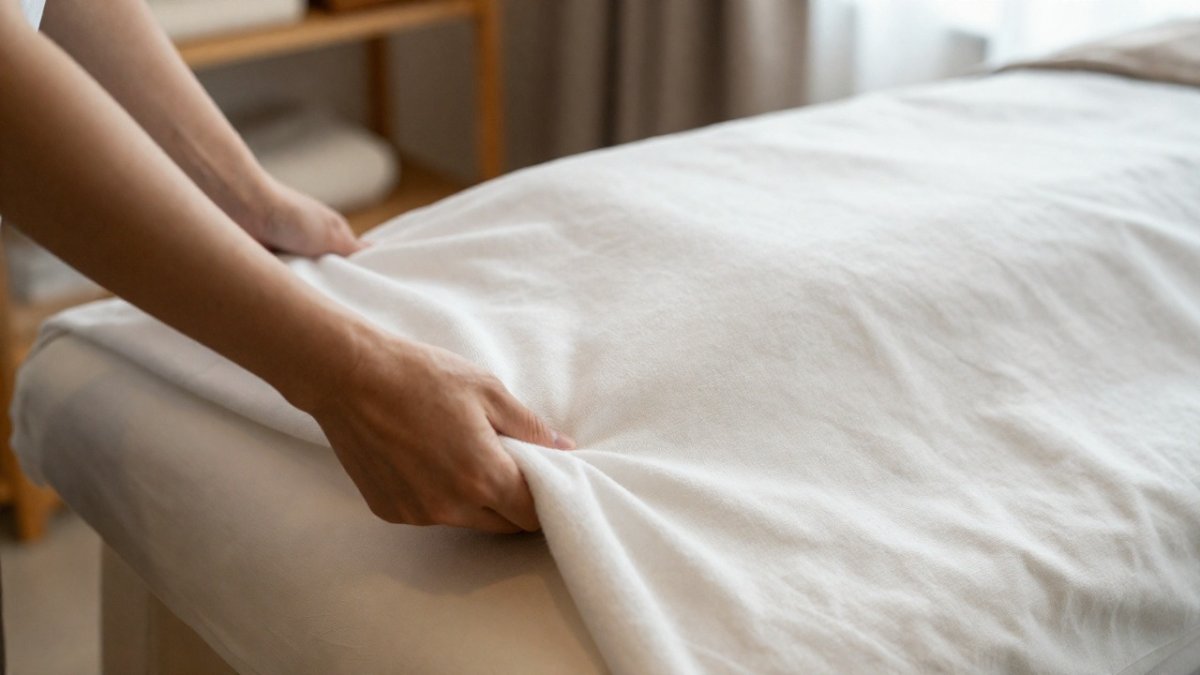
When ordering, pay attention to four things that cause a lot of frustration later:
- Stretch: a fabric with some stretch is easier to tuck in and stays taut. A fitted sheet with elastic all around often works faster on a massage table than a flat sheet.
- Shrinkage: cotton shrinks during the first few washes. Wash a new sheet once at 60 degrees before ordering the final size.
- Anti-slip: an anti-slip layer under the mattress, or a separate anti-slip mat between the mattress and the sheet, prevents shifting during the treatment.
- Opening: for a table with a face opening, the opening must remain clear; a sheet that is too loose hangs over it, a sheet that is too tight closes the opening.
Table linen for massage tables with face openings
A massage table with a face opening requires a sheet that moves with the opening. Measure the distance from the edge of the table to the centre of the opening, and from that centre to the foot end, so you know how much excess you need at the top to fold around the opening without tension.
The practical solution is a sheet with sufficient excess in length. Facilities with a separate pillow set use a separate face cloth better than forcing one large sheet.
Attachment: tucking in, elastic or Velcro
There are three common ways to secure linen on a treatment table, each with its own considerations:
- Tucking in under the mattress works on every table without additional provision, but takes time per change and comes loose on a thin mattress. Suitable for quiet salons.
- Fitted sheet with elastic all around fits snugly and is put on in one motion, but only fits a fixed size and can pull on a mattress of a different thickness. Suitable for busy locations with fixed tables.
- Velcro or an anti-slip mat under the sheet keeps a flat sheet in place without tucking in, but requires an extra step when changing and is more sensitive to wear at the attachment points.
Note: a sheet that is too tightly stretched creates creases that press into the skin, and a sheet that is too loose slips away under a client who turns over. Therefore, stretch the sheet lengthwise first and then widthwise, and check that the opening remains clear before the client takes their place.
Table linen for beauty salons: hygiene and appearance
Hygiene is at the core of business operations in a salon.
For wellness table linen, preferably choose white or light off-white. Not because colour is boring, but because you see dirt and stains immediately.
For appearance, the opposite of what many salons think applies: calm is created by repetition, not by variation. One colour and one texture throughout all treatment rooms works calmer than a mix per room.
Washing and maintaining table linen under intensive use
Washing at 60 degrees is a common temperature for cotton and cotton blends. Do not wash hotter than necessary: hotter washing wears out the fibre faster than dirt ever will. For skin contact, oils and creams, 60 degrees with a full wash cycle is generally sufficient; 90 degrees is only necessary for specific contamination or after a contamination incident, and noticeably accelerates wear.
Four-step washing protocol
- Separate at the source. Throw used sheets directly into a closed laundry bag or container, not on the floor or an open trolley. Keep clean and dirty linen strictly separate.
- Pre-treat where necessary. Treat oil and cream stains with a stain remover or soap before the linen goes into the machine. Do not let a stain dry; a dried oil stain often will not come out at 60 degrees.
- Dose according to water hardness. Do not overdose detergent; residues make the fabric stiff and attract dirt. Follow the dosage on the packaging, not the 'extra scoop' that becomes routine on the shop floor.
- Drying and finishing. Do not dry completely in the machine, because that wrinkles and wears. Take the linen out damp, hang it out or iron only where the guest sees it: the edge and the foot end. Do not iron over elastic or Velcro; that damages fabric and attachment.
Reducing cross-contamination
In a treatment room, linen is one of the most direct transmission routes between clients. A few measures make the difference:
- Use a clean sheet per client and also change the face cloth during a facial treatment.
- Store clean linen in a closed cabinet or container, not open on a shelf in the treatment room.
- Do not wash towels and sheets that come into contact with skin together with cleaning cloths or floor mats.
- Clean the washing machine periodically on a hot cycle with a suitable cleaning agent to prevent biofilm and odour.
Replacement frequency and signs of wear
The wash frequency determines your fabric choice more than your budget. If a sheet goes through the wash three times a day, then cotton-polyester is the sensible choice. In a quiet salon with two treatments per day, you get more out of pure cotton.
Do not replace linen on a fixed calendar but on signs: grey patches that remain after washing, thin patches at the fold, small tears when tucking in and a fabric that feels stiff after drying despite the correct dosage.
Stock, wear and total usage costs per treatment table
The calculation that counts is not the purchase price per sheet, but the price per treatment.
Note: keeping too much stock seems safe, but sheets that lie on the shelf for months discolour and lose their shape.
For the exact sizes and fabric weights, we refer to our range; the price depends on size, fabric and quantity, and you can request a quote for that.
A treatment room that guests experience as calm starts with linen that fits, is clean and does not distract. At Treb Horecalinnen you will find tablecloths, cloth napkins, table runners and table protection that are immediately available from stock, with personal advice on product choice.
Frequently Asked Questions
What material is suitable for table linen in a wellness salon?
Cotton is a common choice for wellness rooms: it feels soft on the skin and absorbs moisture. Linen gives a rustic appearance but wrinkles faster, which means extra ironing. Polyester-cotton blends dry quickly and retain their shape, but feel less pleasant on bare skin. Look per room at how many washes per week you expect and whether guests lie on the linen with wet skin.
What table linen is suitable for a massage table?
For a massage table you want a sheet that stays taut during the treatment and does not shift when the guest turns. Choose a fitted sheet with elastic or a sheet with sufficient overhang on all sides, tailored to the exact length and width of your table. If you work with a face opening, make sure that is taken into account in the fit or use a sheet with an opening. Cotton with a tight weave stays smooth under the hands and pills less.
How do you keep table linen in a spa clean and fresh?
Wash treatment linens after each use at a temperature suitable for the fabric, usually 60 degrees for cotton, and dry them completely before they go back on the table. Store dirty and clean linens separately and count what is needed per treatment, so you never run out of clean sheets. Oil and cream residues from massages are best removed by pre-treating stains before they go in the wash. This keeps the linens fresh for longer and prevents odors in the cabinet.
How often should table linens be replaced in a wellness salon?
Do not replace linens on a fixed calendar but based on wear and tear: thin spots, lint, permanent stains, or a fraying edge are signs that a cloth has had its best days. With intensive use, for example multiple treatments per day, sheets deteriorate faster than in a quiet salon. Keep a minimum stock per size so you can cover wear and tear without having to order the same day. This prevents a guest from ending up on a worn-out cloth.


